

MS channels show up almost everywhere in construction and fabrication, even if people don’t always notice them. They are used because they are strong, adaptable, and fairly easy to work with during installation. A mild steel channel is usually picked when both strength and cost need to stay in balance, which is often the case on real projects. From industrial frameworks to everyday construction supports, MS channel sections are relied on for their durability and consistent shape. On site, engineers and fabricators usually turn to an MS channel weight chart and MS channel size chart to match the section with the span and load involved. Knowing MS channel sizes, weight, and specifications helps avoid overdesign and keeps construction practical, safe, and economical.
|
Table of Content
|
Ms Channel Specification
MS channels are mild steel sections that fabricators and site teams are already comfortable working with. They are chosen mainly because they are strong enough for structural use. Also, they are easy to handle and don’t require special processing during cutting, welding, or fitting on site.
- Commonly made using Mild Steel grades such as IS 2062 A, B, E250, or E350
- Shaped in a simple C or U profile that suits most support work
- Sizes usually fall between 75 × 40 mm and 200 × 75 mm
- Thickness is generally around 4.8 mm to 9 mm, depending on use
- Supplied in standard lengths of about 5 to 12 metres
- Mild steel channel unit weight changes with section size and thickness
- Most channels come in a hot-rolled black finish, with coating added if needed
Types of MS Channels
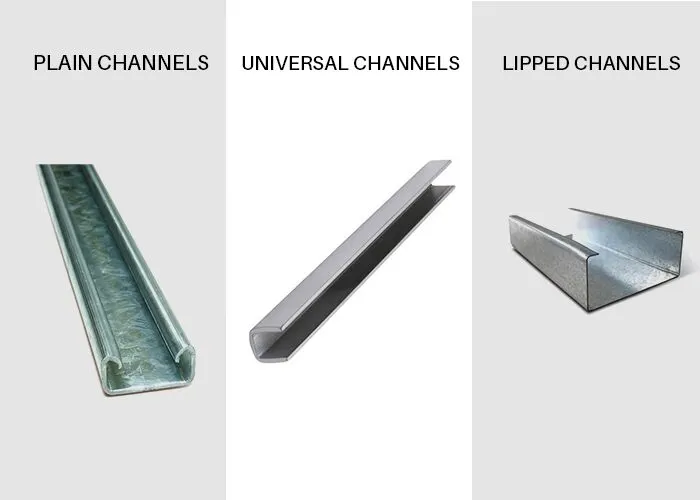
Three types of MS Channels are typically used in industries:
In everyday industrial use, MS channels are usually grouped by how they behave on site rather than by strict definitions. These MS channel types are chosen based on ease of handling, fabrication needs, and the kind of load or support the structure demands.
-
Plain Channels: A plain channel is a kind of metal bracket that is designed specifically to act as a channel support system for installation work or construction activities including plumbing, electrical work, and mechanical works. A plain mild steel channel is often treated as a simple support member rather than a heavy structural section. It is commonly used during plumbing, electrical, and mechanical installation work where alignment and fixing matter more than high load capacity. This MS channel type is preferred when flexibility and ease of adjustment are required.
-
Universal Channels: These channels allow diverse forms of work such as drilling, welding, and/or cutting thereby making them suitable for a rich variety of applications. Universal channels are selected when fabrication work is expected to change or evolve. They handle drilling, welding, and cutting without difficulty, which makes them practical in workshops and industrial frames. A mild steel channel of this type is useful where adaptability is more important than a fixed design.
-
Lipped Channels: Lipped channels are typically designed as structural components in the erection of structures and/or They are known for their exceptional load-bearing capacity construction of buildings. Lipped channels are typically used when extra stiffness is needed without moving to heavier sections. The added lips improve stability and help control bending under load. Among common MS channel types, these are often chosen for building frameworks and structural supports where strength must remain consistent.
Mild Steel Channel Unit Weight
The unit weight of mild steel refers to how heavy an MS channel is for every metre of length. This matters when estimating material, planning transport, or checking loads. The weight is worked out using a simple relationship:
Weight (kg/m) = Volume × Density of steel
Steel density is taken as 7850 kg/m³, while the volume comes from the channel’s cross-section and length. Since working this out every time isn’t practical, most engineers prefer using a weight chart of MS channel to get reliable figures quickly.
MS Channels Weight and Size Chart
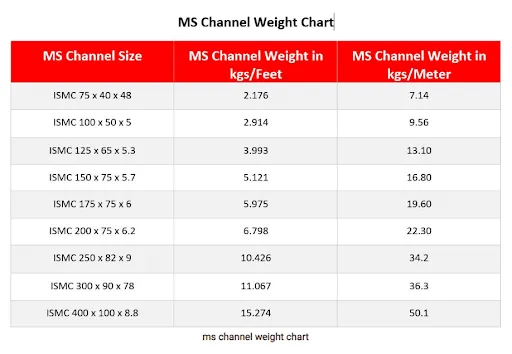
The weight and dimensions of an MS channel can vary noticeably based on its section size, thickness, and overall design. This is why referring to a reliable MS channel weight chart is important before finalising material selection. Standard charts list MS channel sizes along with corresponding weights, helping engineers match load requirements with the right section. A detailed weight chart of MS channel also supports accurate cost estimation and material planning. While online calculators are useful, manufacturer-provided charts remain the most dependable reference for checking MS channel weight and dimensions.
Also Read: Guide to Calculating MS Angle Weight: Advantages, Weight chart
Advantages of MS Channels
MS channels are used widely. This is simply because they work well in day-to-day construction and fabrication. They are familiar and easy to handle. Also, they fit into most structural jobs without needing special treatment or complicated planning.
Strength and Durability
In normal use, MS channels handle regular loads without much trouble. They tend to hold their shape over time. This is why they are often used in frames and supports that are expected to stay in place for years.
Cost Effectiveness
Mild steel is generally easier on the budget than many other structural materials. Because of this, MS channels are often chosen when costs need to be controlled while still meeting basic strength and safety needs.
Versatility
MS channels are used in many different situations because they don’t lock designers into one approach. They can be adapted on site when layouts change or adjustments are required. This is because they are available in multiple sizes.
Convenient Fabrication
Fabricators usually find MS channels straightforward to work with. Cutting, welding, and drilling can be done using common tools. This helps keep work moving even when changes come up during construction.
Corrosion Protection Options
Simple surface treatments are often applied when MS channels are exposed to weather or moisture. Painting or coating helps reduce surface damage. It also improves how long the material lasts in outdoor conditions.
Allows Carburising
MS channels are carburised to improve surface hardness in some cases. This process toughens the outer layer. However, it keeps the inside less brittle. This can be useful where wear becomes an issue.
Recyclability
Once they are no longer in use, MS channels can be collected and reused. Their magnetic nature makes sorting easier, allowing the steel to be recycled and used again in new applications.
Uses of MS Channels

MS channels are used in many projects. This is simply because they are familiar and easy to work with. They often end up being the practical choice for framing, support, and reinforcement work without much complication.
1. Structural Support
MS channels are used as support members within frames on most construction sites. They help carry walls and connect different structural parts. Over time, this adds stiffness and helps buildings handle loads more evenly in residential and industrial settings.
2. Roofing and Flooring Systems
MS channels are commonly placed beneath roofing sheets and floor panels. They are used as joists or purlins. These help spread weight across spans. This usually helps prevent sagging and keeps roofs and floors performing steadily during regular use.
3. Racks and Shelves
MS channels are often chosen because they are strong but not difficult to handle in storage areas. They form simple frames for racks and shelves. This allows materials and equipment to be stored safely in warehouses and workshops.
4. Material Handling Equipment
MS channels are frequently used in material handling systems as part of the supporting structure. Conveyors, cranes, and trailers rely on them. They help to carry loads and guide movement. Their steady behaviour helps equipment operate smoothly over repeated cycles.
5. Vehicle and Machinery Frames
MS channels are used where vibration and stress are common in vehicles and machinery. They help keep the frame in shape and support components during operation. These are especially helpful when equipment runs for long hours or under changing conditions.
6. Support Structures in Bridges
In bridge projects, MS channels are generally used in secondary support elements. They help share loads caused by traffic and movement. Over time, this supports balance and contributes to the structure’s overall performance.
Also Read: Unlocking the Strength and Versatility of Austenitic Stainless Steel
Conclusion
Understanding MS C-channels helps in making better decisions during planning, fabrication, and construction. Also, choosing the right section is not only about price. Its also about consistency, availability, and long-term performance on site. This is where Sree Metaliks Limited fits into the picture. With its established presence in India’s steel industry, the company supplies MS channels that meet standard specifications and practical construction needs. Builders and fabricators rely on this consistency when timelines and structural requirements matter. Sree Metaliks Limited supports projects that demand strength, reliability, and efficiency from start to finish.
Key Takeaways
- MS channels (mild steel channels) are C- or U-shaped structural steel sections used in construction and fabrication.
- They are known for high strength, durability, and excellent load-bearing capacity in structural applications.
- Common sizes range from 75×40 mm to 200×75 mm with standard lengths of 5–12 meters.
- Types include plain channels, universal channels, and lipped channels based on application needs.
- MS channels are easy to cut, weld, and fabricate, making them highly versatile for projects.
- They are widely used in structural frames, roofing systems, machinery, bridges, and industrial frameworks.